
The Nordic Shift: VR as the New Safety Training Standard
Updated: Aug 26
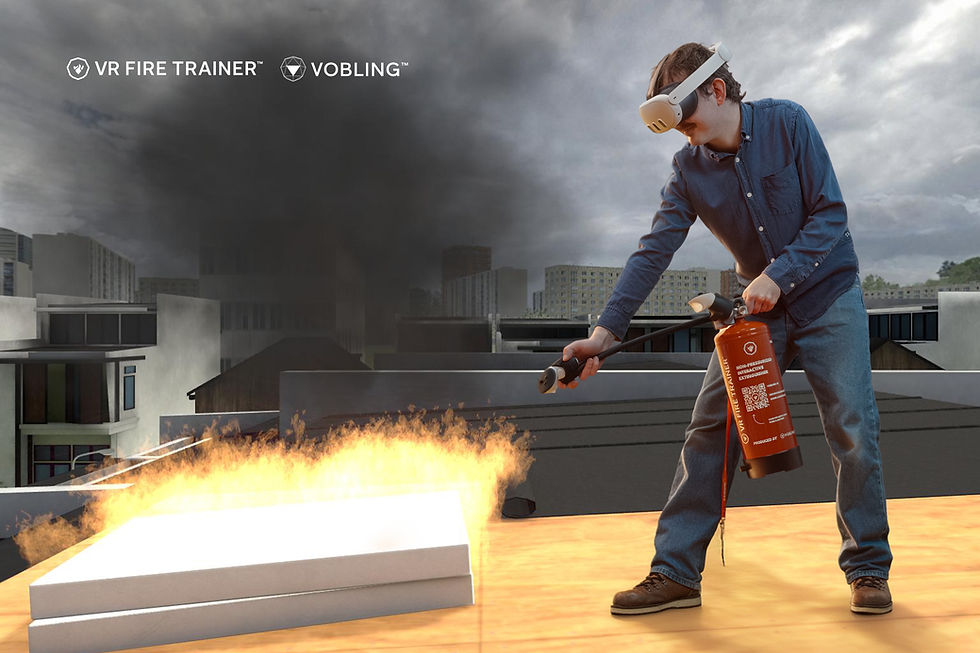
With Norway transitioning to VR-based training for Hot Work in 2027, the paradigm of industrial safety is fundamentally changing. Traditional compliance is no longer enough - real preparedness is the new benchmark.
By the Vobling Team
For decades, workplace safety training has followed a predictable, analog formula. Employees gather, look at a presentation, perhaps extinguish a controlled gas fire on a sunny day, and receive a certificate. It ticks the box for compliance.
But does it actually prepare a person for a real crisis?
The short answer is no. And Nordic regulatory bodies are starting to act on it.
The most significant indicator of this shift is happening right now: By 2027, Norway is transitioning completely to virtual reality (VR) for Hot Work training.
This is not a temporary tech trend. It is a regulatory validation of immersive technology, signaling a massive shift for companies across Sweden, the Nordics, and Europe. The question is no longer if you should implement VR safety training, but when.
Here is why the industry is moving beyond one-time compliance, and how forward-thinking organizations are adapting today.
1. The Regulatory Validation: VR is No Longer Just "Tech Hype"
One of the biggest hurdles for immersive technology in traditional industries has been the misconception that VR is a gimmick. Norway’s upcoming 2027 mandate completely dismantles that argument.
When a nation standardizes VR for high-risk training like Hot Work, it is based on data, safety statistics, and proven efficacy. Regulatory bodies recognize that traditional fire training cannot safely or logistically replicate the complexity of modern industrial environments.
For safety managers and instructors across the Nordics, this is a wake-up call. The requirements coming to Norway today are a blueprint for European safety standards tomorrow. Waiting until local laws force a change means falling behind. Future-proofing your organization starts now.
2. The Science of Survival: Building Muscle Memory Under Stress
Why are authorities pushing for VR? Because human psychology proves that traditional training fails when panic sets in.
The Forgetting Curve: First mapped by psychologist Hermann Ebbinghaus and backed by modern neuroscience, data shows that humans forget up to 70% of newly acquired theoretical information within just 24 hours if it is not put into practice. Without continuous repetition or physical engagement, only a fraction of your safety training budget actually sticks.
Furthermore, extinguishing a predictable fire in a parking lot does not prepare the brain for the cognitive overload of a real workplace emergency.
The Power of Presence: VR fools the brain into believing the experience is real. When a user puts on a headset, they experience the visual and auditory stress of a sudden fire.
Muscle Memory: By physically picking up a simulated extinguisher, pulling the pin, and assessing the fire type, the user builds kinetic muscle memory.
Safe Failure: In VR, users can make mistakes. They can choose the wrong extinguishing agent or fail to secure an exit - and learn from those life-threatening mistakes in a 100% safe environment.
This moves organizations away from a passive "checklist mentality" and toward genuine, measurable muscle memory.
3. The Enterprise Advantage: Scaling Without the Smoke
Beyond compliance and pedagogy, transitioning to digital tools like our Vobling VR Fire Trainer solves three of the biggest operational headaches for enterprise companies: Logistics, Cost, and ESG (Sustainability).
Unlimited Scalability
Traditional fire training is heavily dependent on weather, specialized instructors, and heavy logistics. With a portable VR solution, a company can train 5 or 5,000 employees, on-demand, across multiple global sites - with total consistency in training quality.
Measurable Data over Gut Feeling
Traditional certificates prove someone attended a course. VR training provides actual data. Safety managers can measure exact response times, precision, and decision-making metrics. This turns safety from a guessing game into a measurable KPI.
Zero Emissions, Zero Waste
Traditional training requires burning fossil fuels, discharging chemical foams, and polluting the environment. Our Vobling VR Fire Trainer allows for infinite repetition with zero carbon footprint, aligning perfectly with modern corporate ESG targets.
Conclusion: The Future is Immersive
The countdown to 2027 has begun. As Norway sets the new standard for Hot Work, the rest of the market will inevitably follow.
Relying on old methods is no longer a sign of tradition - it is a compliance risk and an operational inefficiency. Our goal with our Vobling VR Fire Trainer is to bridge the gap between basic compliance and real, life-saving preparedness.
The standard has been raised. Is your organization ready?
Ready to future-proof your safety training?
Contact our team directly at info@vobling.com to book a demo of our Vobling VR Fire Trainer today, or to learn how we can help your organization transition to next-generation safety training.


